
92%
of candidates experience interview anxiety
TopInterview survey
1 in 6
people avoid job applications due to interview fear
Anxiety UK
2× better
performance when anxiety is reframed as excitement
Harvard Business School
Job interview nerves are not a personality flaw. They are a physiological response. Your body releases adrenaline and cortisol because it has correctly identified that something important is happening. The racing heart, the dry mouth, the feeling that your brain has temporarily left the building. That is your nervous system doing its job.
The problem is not the anxiety. The problem is what most people do with it. They interpret the physical symptoms as evidence they are going to fail, which creates a spiral that makes the stress worse. Harvard researchfound that simply reframing the feeling, telling yourself “I am excited” rather than “I am nervous”, measurably improved performance under pressure. Same adrenaline. Different story.
What follows is a practical, phase-by-phase guide to calming interview nerves. From the night before to the moment you walk back out. Not motivational fluff. Actual techniques that work.
The most important mindset shift
Nervousness and excitement produce identical physical symptoms. Your heart rate rises. Your palms sweat. Your senses sharpen. The only difference is the story you tell yourself about what those feelings mean. Before your next interview, try saying out loud: “I'm excited.” It sounds simple. The research says it works.
The night before
Prepare your answers out loud — not in your head
Thinking through answers and saying them are completely different skills. Run through your top five likely questions and answer them aloud. This is the single biggest thing you can do to reduce mind blanks on the day.
Research until you stop worrying about research
Anxiety loves uncertainty. If you're still vague on what the company does, who your interviewers are, or what the role actually involves, you haven't researched enough. Nail those down tonight so tomorrow's nerves are about performance, not preparation.
Prepare your questions to ask them
Walking in with nothing to ask at the end creates a psychological vulnerability. Having two or three good questions ready gives you something to look forward to rather than dread.
Get everything physical sorted
Clothes, route, time, parking, login link. Every logistical uncertainty adds a small layer of background stress. Eliminate them tonight so tomorrow morning is frictionless.
Go to sleep at a reasonable time
One bad night's sleep will not ruin an interview. Chronic sleep deprivation will. If you can't sleep, don't stress about it. Rest is still useful even if you're not fully out. Avoid scrolling job boards or LinkedIn at midnight.
Morning of the interview
Eat something proper
Low blood sugar and high cortisol is a bad combination. Eat a real meal. Avoid too much caffeine — it amplifies the physical stress response and makes the racing heart feeling worse.
Move your body
A 15-minute walk before arriving burns off excess adrenaline and is one of the most effective natural anxiety regulators available. If you're doing a video interview, do it before you log on.
Arrive or log on early
Rushing to an interview is one of the most reliable ways to arrive in a poor mental state. Give yourself a ten-minute buffer. Arrive, breathe, collect yourself. For video interviews, open the link five minutes early and check your setup works.
Do not over-rehearse in the car
Running through answers on a loop in the forty minutes before you go in usually makes things worse. It creates a performance mindset rather than a conversation mindset. Trust your preparation. Distract yourself with music or a podcast instead.
In the room (or on the call)
Slow down your speech
Nerves make people talk faster. Consciously speak at about 80% of your normal pace. It reads as confidence to the interviewer, and it gives your brain more time to form complete thoughts.
Take time to think before answering
Saying "let me think about that for a second" before a complex answer is not a weakness. It's what thoughtful people do. Interviewers notice and respect it. Rambling immediately into a half-formed answer is what looks bad.
Treat it like a conversation, not an evaluation
The interview is not a test you pass or fail. It's a conversation between two parties working out if there's a good fit. You are assessing them as much as they are assessing you. This reframe reduces the psychological pressure significantly.
Use your notepad
Bringing a notepad is not a crutch. It's a signal that you're organised and prepared. Write down the interviewer's questions if you need to. Glance at your prepared examples. Nobody marks you down for being prepared.
When it goes wrong, keep going
Every candidate fluffs an answer. What separates good candidates from bad ones is recovery speed. If you give a poor answer, don't carry it into the next question. Reset, breathe, move on. The interviewer will often forget a weak answer if the overall impression is strong.
Regulate your nervous system in 90 seconds
Box breathing activates the parasympathetic nervous system and measurably reduces cortisol. Do this in the car, the lift, or the toilet before you go in.
Inhale
4 counts
Hold
4 counts
Exhale
4 counts
Hold
4 counts
Repeat 4–5 times. Works best when started at least 5 minutes before the interview begins.
Body language signals confidence, even when you don't feel it
Your body language affects not just how the interviewer reads you, but how you feel. Research consistently shows that posture influences stress hormone levels. You don't need power poses. You need to avoid the body language of anxiety.
Do
- ✓Sit upright with feet flat on the floor
- ✓Make natural, comfortable eye contact
- ✓Pause before answering. It reads as confidence
- ✓Use your hands naturally when you speak
- ✓Smile when you first meet them. It releases tension
Avoid
- ✗Crossing your arms (signals defensiveness)
- ✗Looking down or away when answering
- ✗Fidgeting with your hands or pen
- ✗Rushing your answers to fill silence
- ✗Apologising for nerves more than once
Managing negative self-talk before you go in
Most pre-interview anxiety is driven by a loop of worst-case thinking. “I'll forget everything.” “They'll ask something I don't know.” “I'm not good enough for this.” These thoughts feel like warnings. They are not. They are habits.
The most practical counter to negative self-talk is not positive affirmations. It is evidence. Write down three specific things you have done well in your career that are relevant to this role. Not vague statements. Actual examples with numbers or outcomes. Reading those back before you go in is more effective than telling yourself you're great.
And remember: imposter syndrome is most common in competent people. The candidates who feel completely unworried going in are usually either very experienced or not fully grasping what's at stake. A degree of nervousness is a sign you care. That's not something to suppress. It's something to channel.
The single most effective thing you can do
Do a mock interview. Find a friend, a family member, or record yourself on your phone. Answer your top five likely questions out loud, in full, as if you're in the room. This is uncomfortable. That discomfort is the point. You want the first time you feel awkward saying your answers to be at home, not in front of the interviewer. Most candidates skip this step. Most candidates also underperform.
Generate your tailored interview questions — free →Frequently asked questions
Why do I get so nervous before a job interview?▼
Interview nerves are a physiological stress response. Your body releases adrenaline and cortisol because it perceives the interview as high-stakes. This is completely normal. The physical symptoms are the same ones athletes feel before competition. The problem is not the nervousness itself. It's interpreting those symptoms as a sign you're going to fail. Reframing the response as excitement is one of the most evidence-backed techniques for improving performance under pressure.
How do I calm interview nerves fast?▼
Box breathing (inhale 4 counts, hold 4, exhale 4, hold 4) activates the parasympathetic nervous system within 60 to 90 seconds and measurably reduces cortisol. Do it before you go in. Avoid caffeine on the day as it amplifies the physical stress response. A short walk beforehand also burns off excess adrenaline effectively.
Is it OK to tell an interviewer you're nervous?▼
Yes, briefly. Frame it positively. "I'm a little nervous because I'm genuinely excited about this role" is fine. It's honest and most interviewers respond well. What to avoid is repeatedly apologising for nerves or letting it derail your answers. Say it once, move on, and let your preparation do the work.
How do I stop my mind going blank in an interview?▼
Mind blanks are almost always caused by underprepared answers rather than genuine memory failure. The fix is practising out loud before the interview. When you feel your mind going blank in the room, buy time: "Let me think for a moment." Bring a notepad with your key examples. It's completely acceptable to glance at notes. The interviewer wants to hire you.
How can I feel more confident in a job interview?▼
Confidence comes from preparation, not from suppressing nerves. The candidates who appear confident have practised their answers out loud, know their CV cold, researched the company, and have questions ready to ask. Body language helps too. Sit upright, make natural eye contact, speak at 80% of your normal speed. But none of that works without the preparation underneath it.
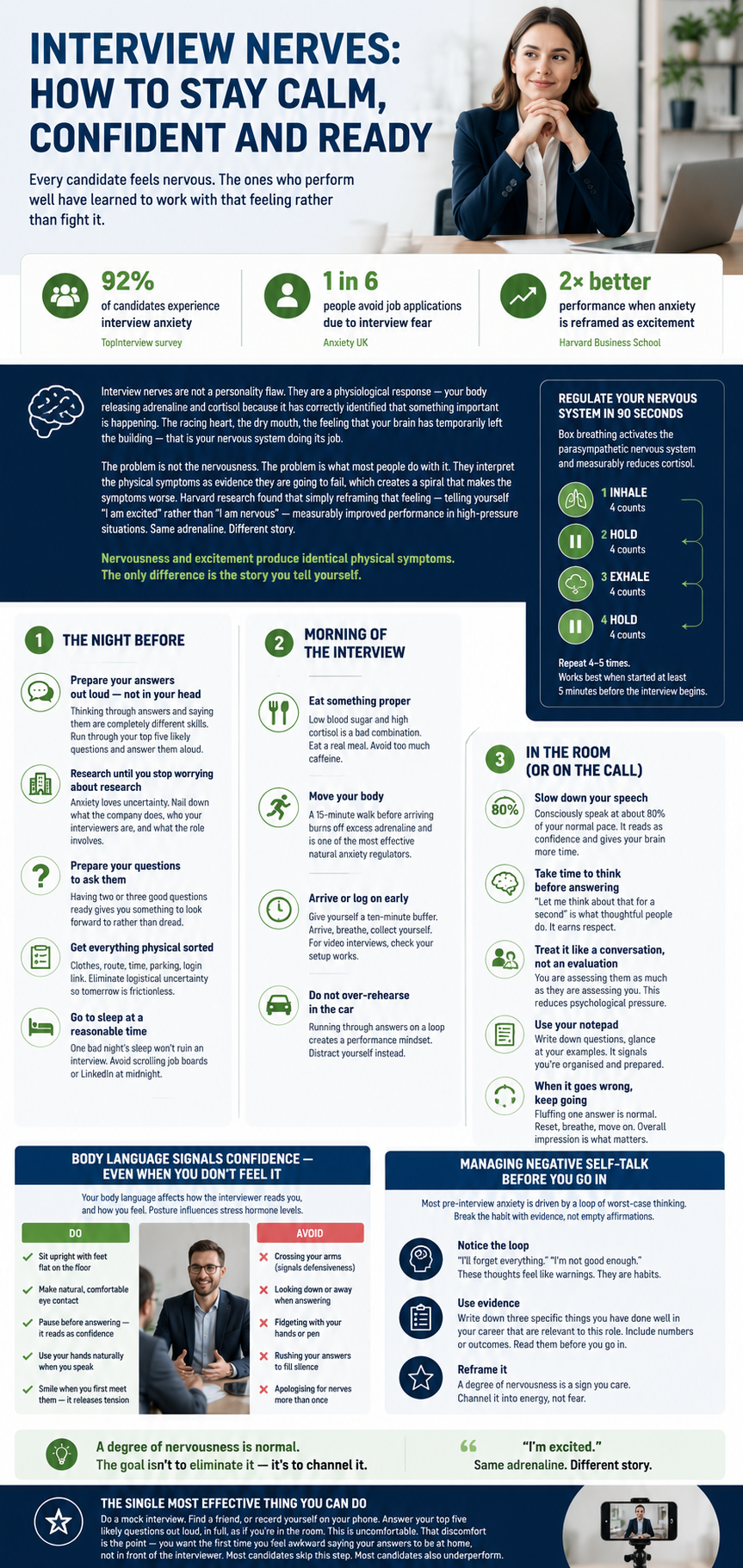
Save or share this.
Walk in prepared, not just hopeful
The best way to reduce interview nerves is preparation. Generate 20 tailored interview questions based on your CV and the job spec, so nothing catches you off guard.
Generate my interview questions — free →Paresh Patel
LinkedIn →Founder, MonkCV — free career tools for job seekers
Every article is researched and written using primary sources — WEF reports, ONS data, Goldman Sachs research and real hiring data. MonkCV is free because good career advice shouldn't cost £200/month. How MonkCV works →
Read next

The Questions You Should Be Asking in Your Interview
"Do you have any questions for us?" is not the end of the interview. It's your turn.
6 min read

10 Things You Must Know About a Company Before Your Interview
Most candidates turn up knowing the job title and where the office is. Here's how to research properly.
5 min read
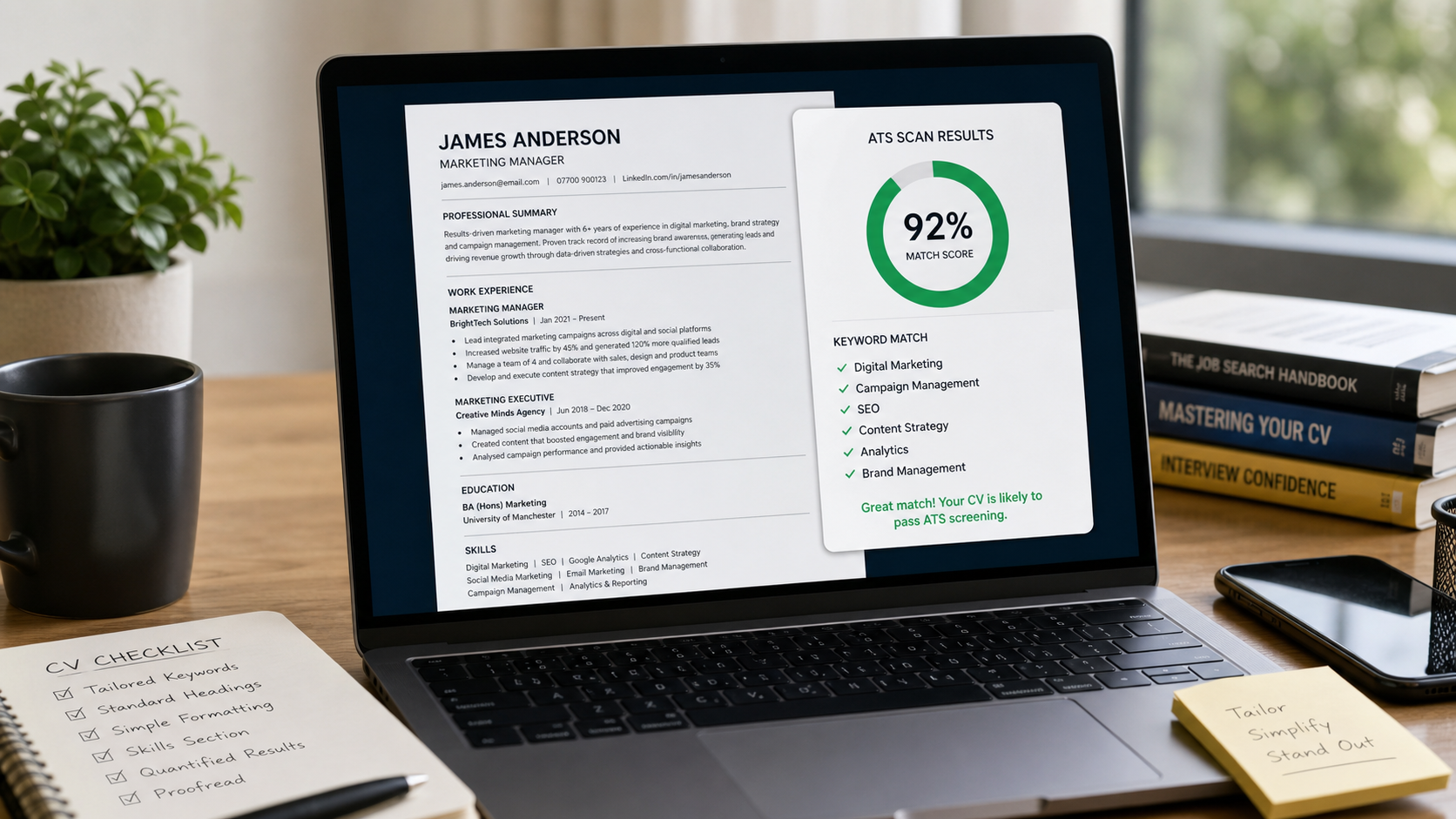
What ATS Actually Looks For — And How to Beat It
Three in four CVs are rejected by a machine before any human reads them. Here's how to fix yours.
6 min read