
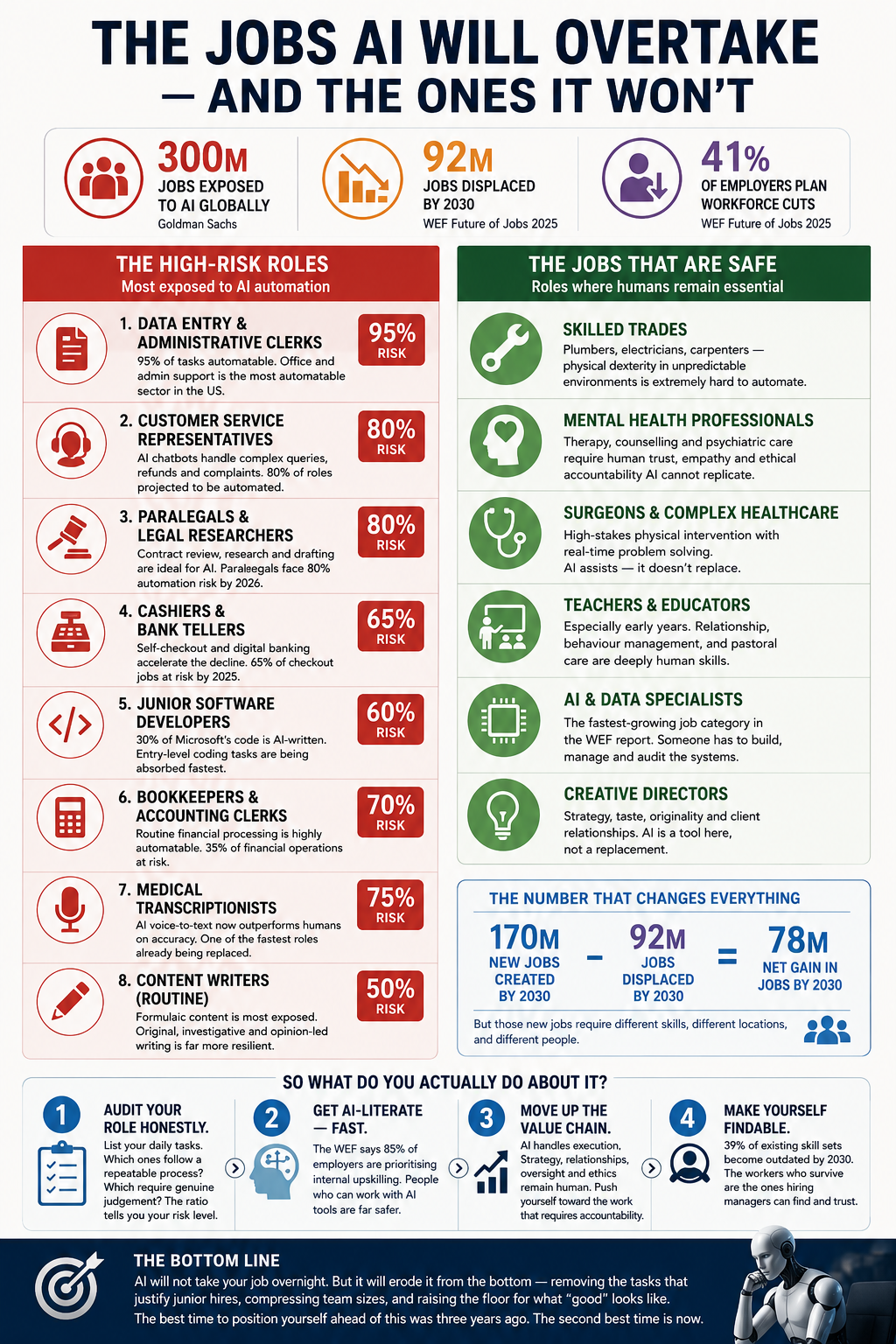
300M
jobs at risk from AI globally
Goldman Sachs
92M
jobs displaced by 2030
WEF Future of Jobs 2025
41%
of employers plan workforce cuts
WEF Future of Jobs 2025
People keep talking about AI taking jobs as if it's something that's going to happen. It's happening. In the first six months of 2025, 77,999 tech workers lost their jobs directly because of AI. That's 427 people a day. Every day.
And here's the part that catches people off guard: it's not factory workers going first this time. It's office workers. It's the people who spend their days reading documents, filling spreadsheets, writing emails, answering calls, and processing forms. If your job is essentially moving information from one place to another — you're closer to the front of the queue than you probably think.
The High-Risk Roles
Data Entry & Administrative Clerks
95% risk95% of tasks automatable
This one is basically done. AI processes documents faster, cheaper and more accurately than any human — over 1,000 per hour with an error rate under 0.1%. Goldman Sachs puts office and admin support at the top of the automation pile: 46% of all tasks gone. The WEF lists data entry clerks as one of the fastest-declining jobs to 2030. If your job is moving information from one box to another, it's already being replaced.
Customer Service Representatives
80% risk2.24 million US jobs at risk
AI can now handle refunds, complaints, account changes and product questions without a human anywhere near it. Companies are saving $8 billion a year by switching. 80% of customer service roles are projected to go. The ones that survive are the genuinely complex, emotionally charged situations — and those will need far fewer people.
Paralegals & Legal Researchers
80% riskLegal work 44% automatable (Goldman Sachs)
Reading contracts, finding precedents, drafting standard clauses — this is bread and butter for an LLM. Goldman Sachs ranks legal second only to admin for automation risk. Paralegals face 80% risk by 2026. Legal researchers 65% by 2027. The senior lawyers who interpret, argue and advise are fine. The junior ones doing document review at £40k a year are not.
Cashiers & Bank Tellers
65% risk65% of checkout jobs at risk
This one has been coming for ten years and AI is just finishing the job. Self-checkout, mobile payments and automated banking apps have already gutted the numbers. The WEF puts bank tellers and cashiers firmly in the fastest-declining roles to 2030. There's no real counter-argument here.
Junior Software Developers
60% risk30% of Microsoft's code is now AI-written
Satya Nadella said it plainly: 30% of Microsoft's code is now written by AI. Over 40% of their recent layoffs hit software engineers. The junior end of coding — boilerplate, unit tests, bug fixes, simple features — is going fast. This doesn't mean developers are finished. It means the entry-level ladder has a missing rung, and the ones who thrive will be those who can direct and review AI output rather than just write code.
Bookkeepers & Accounting Clerks
70% risk35% of financial operations automatable
Payroll, reconciliation, tax prep, expense processing — all rule-based, all structured, all very easy for AI to do faster and cheaper. Goldman Sachs puts financial operations in the top five most at-risk sectors. Chartered accountants who advise clients will be fine. The people processing spreadsheets all day are in real trouble.
Medical Transcriptionists
75% riskAI transcription now outperforms humans
Tools like Nuance's DAX Copilot are already running in thousands of hospitals and clinics. They're faster, they don't get tired, and their accuracy now beats trained human transcriptionists. This isn't a future threat — people in this role are already being let go. It's one of the clearest examples of AI replacing a job in real time rather than just threatening it.
Content Writers (Routine)
50% riskFormulaic content most at risk
Product descriptions, SEO filler, boilerplate press releases, templated blog posts — already being produced at scale by AI. If your writing is interchangeable with anyone else's, it's interchangeable with a machine's too. Writers who have a genuine voice, a point of view, and can be accountable for what they say are a different story. But there are fewer of those jobs than people think.
The number that changes everything
The WEF says 170 million new jobs will be created by 2030 against 92 million lost. Net positive. Great. But the person losing their admin job in Coventry is not automatically the person building AI infrastructure in a data centre. The numbers balance out on a spreadsheet. They don't balance out in people's lives. Don't let the optimistic headline distract you from the personal maths.
The Jobs That Are Safe
Not everything is going. The roles that survive tend to share one thing: they require you to show up — physically, emotionally, or creatively — in a way a machine genuinely can't fake yet.
Skilled Trades
A robot can't unblock your drain or rewire your fuse box. Physical work in unpredictable environments is genuinely hard to automate — and these jobs are already short of people.
Mental Health Professionals
People will talk to a chatbot. They won't trust it with their darkest thoughts. Therapy relies on human presence, genuine accountability, and a relationship built over time.
Surgeons & Complex Healthcare
AI assists in diagnostics and imaging — it doesn't hold the scalpel. High-stakes, high-variability physical intervention stays human.
Teachers & Educators
Especially with younger children. A classroom isn't just content delivery — it's behaviour, relationships, pastoral care, reading the room. Hard to outsource.
AI & Data Specialists
The fastest-growing job category in the WEF report, full stop. Someone has to build, run and keep an eye on all of this. That someone is very employable right now.
Creative Directors
AI produces. It doesn't edit with taste, push back on a client, or know when something's just not right. Senior creative judgement has a long runway.
Share this — the more people know, the better they can prepare.
The Companies Already Doing It
This isn't hypothetical. In 2024–2025, the most profitable companies in the world cut tens of thousands of jobs — while posting record revenues. Many named AI directly as the reason. These aren't redundancy cycles. They're structural changes.
Latest — May 2026
Cloudflare cuts 1,100 jobs while profitable
CEO Matthew Prince told staff the layoffs weren't because Cloudflare is struggling — the company is growing. The roles are going because the work behind them no longer needs that many people. The clearest signal yet that this is no longer a downturn story.
15,000+
jobs cut
Microsoft
Two rounds of cuts in 2025 — 6,000 in May, 9,000 in July. Roughly 40% hit software engineers. Satya Nadella confirmed 30% of the company's code is now written by AI. They're not replacing those developers.
8,000
jobs cut
Meta
10% of the workforce gone in early 2025. Recruiting, HR and middle management absorbed the bulk. Zuckerberg's stated goal: a "leaner" company running on AI agents for tasks that used to need teams.
30,000
jobs cut
Amazon
Around 10% of corporate headcount removed since October 2024. The company simultaneously doubled its AI and robotics investment. The two facts are connected.
4,000
jobs cut
Salesforce
Customer support roles specifically. CEO Marc Benioff was direct: "I need less heads." The company now sells AI agents to replace the same functions they let staff go from.
700
jobs cut
Klarna
Replaced their entire customer service function with an AI chatbot — then reversed course 578 days later and started rehiring. The AI handled volume but couldn't handle the edge cases. Clients noticed.
100 contractors
jobs cut
Duolingo
About 10% of their contractor workforce, mostly lesson writers. The work is now done by AI. Duolingo called it an "AI-first" transition. The contractors called it losing their jobs.
1,750
jobs cut
Workday
8.5% of the entire company. The money saved is being redirected into AI product development. This is the pattern across enterprise software: cut people, invest in AI, sell that AI to companies who then cut more people.
1,100
jobs cut
Cloudflare
Announced May 2026. CEO Matthew Prince was unusually candid — he said he personally signed every offer letter, and that the cuts were not because Cloudflare is struggling. Revenue is up. The company is profitable. The roles are going anyway, because the work behind them no longer needs that many people. This is the new pattern: healthy companies, growing revenue, shrinking headcount.
Hundreds
jobs cut
IBM
HR and back-office roles replaced by AI agents over 18 months. CEO Arvind Krishna said he expected AI to replace around 7,800 roles in total. IBM isn't alone — they're just more willing to say it.
The wider number
Challenger, Gray & Christmas — the firm that tracks corporate layoffs — recorded approximately 55,000 AI-attributed job cuts in 2025 alone. That's what companies are willing to publicly attribute to AI. The real number is higher.
So what do you actually do about it?
Be honest about what you actually do all day.
Write down your last five days of tasks. How many of them follow a repeatable process? How many require you to make a call that only you could make? That ratio is your risk level.
Learn to use the tools, not fight them.
85% of employers are already investing in AI upskilling internally. The people who figure out how to use AI well will absorb the work of the people who don't. That's already happening in most industries.
Get closer to the decisions, not the tasks.
AI is good at doing things. It's not good at deciding what to do, why, and whether it was right. Opinions, judgement, relationships and accountability are where the remaining value sits.
Make sure people can find you.
39% of skill sets will be outdated by 2030. The workers who land on their feet are the ones who make themselves easy to find and easy to trust — a CV that's actually current, a LinkedIn that says something, a reputation that travels.
The bottom line
Your job probably won't disappear overnight. What's more likely is that the team around you quietly shrinks, the entry-level roles stop getting refilled, and suddenly you're expected to do 30% more with tools you've never been trained on. The people who saw that coming and got ahead of it will be fine. The ones who assumed it wouldn't reach them are the ones reading job listings right now.
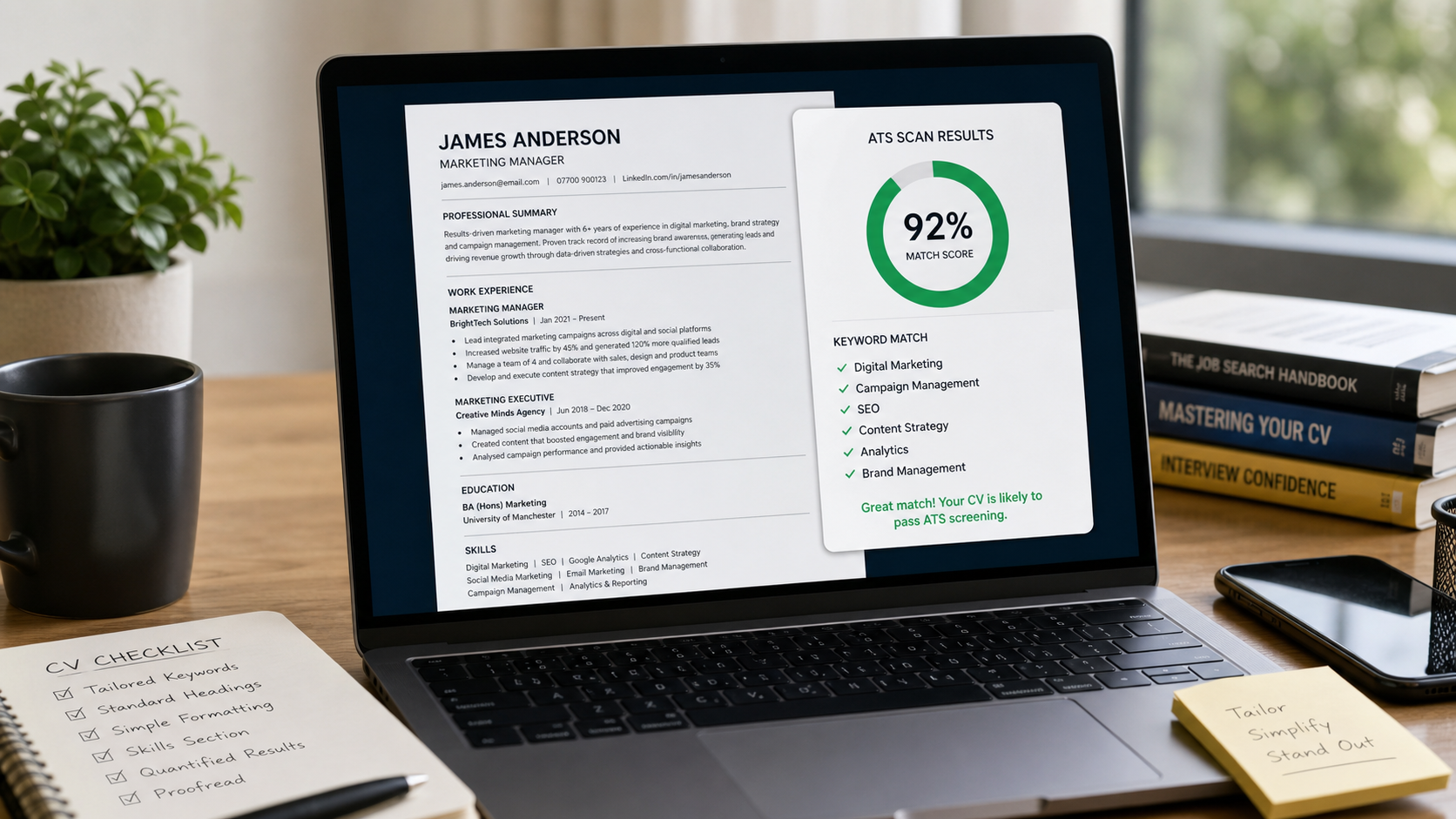
Make your CV AI-proof
In a market where AI is screening candidates too, your CV needs to pass the machine and impress the human. MonkCV does both — free.
Optimise my CV — free →Sources & Further Reading
Paresh Patel
LinkedIn →Founder, MonkCV — free career tools for job seekers
Every article is researched and written using primary sources — WEF reports, ONS data, Goldman Sachs research and real hiring data. MonkCV is free because good career advice shouldn't cost £200/month. How MonkCV works →